


A crowd of people affected by government land seizures yesterday braved the forefront of Typhoon Nanmadol to rally outside the Executive Yuan and protest the “pre-auction” measure used in development projects, calling for negotiations with landowners.
“President Ma Ying-jeou (馬英九) talked about justice in housing and justice in land use, but we don’t feel he’s been sincere, because our problems have not been solved and everything continues as before,” MRT A7 Station Development Project Self-Help Group chairwoman Hsu Yu-hung (徐玉紅) said.
“We demand that the government stop the expropriation project and stop the ‘pre-auction,’ which has no legal basis,” Hsu said.
The “MRT A7 Station Development Project” refers to plans to create an industrial zone, a commercial zone, regular housing complexes and “suitable housing” complexes near the station, now temporarily named “A7,” along an express railroad connecting central Taipei and Taiwan Taoyuan International Airport.
Although the Ministry of the Interior, which initiated the project, said the project was to build “suitable housing complexes” to be sold at lower prices as a measure to cool down the skyrocketing real- estate market, affected residents believe the government is only trying to help land developers. This was because of the 186 hectares of land to be expropriated, only 9.7 hectares would be used to build “suitable housing,” while 43.52 hectares would be turned into an industrial zone and the rest would become regular housing or commercial zones.
Residents are also upset that, before the expropriation process has been completed, the government is already inviting bids.
“We still live here, we still have land ownership certificates in our hands, how could the government put our land on ‘pre-auction?’” Hsu asked. “The government says land ownership would not be transferred to a new owner until the expropriation process is completed. Well, this is like putting a knife to our throats and telling us: ‘Don’t worry, we won’t kill you right away.’”
Liao Pen-chuan (廖本全), an as-sociate professor in National Taipei University’s department of real estate and built environment, who attended the protest to show his support for the protesters’ demands, agreed with Shih.
“I want to ask the government three questions: First, there are already too many development projects, has the government done an evaluation on the public interests and necessity of the A7 development project? Second, what is the legal basis of ‘pre-auction’ and, third, who made the decision to put private land on ‘pre-auction?’” he asked.
“If the president cannot realize justice in housing and justice in land use for these people protesting here, he should just shut up,” Liao added.
After handing a petition to an official surnamed Lin of the ministry’s Department of Land Administration in front of the Executive Yuan, the protesters handed in a petition letter at the Presidential Office.
There was some minor verbal clashes and some pushing and shoving when the Executive Yuan initially sent a security officer to receive the petition.
Asked to comment on the “pre-auction,” Department of Land Administration Director Hsiao Fu-tao (蕭輔導) said that the measure had no basis in law, but defended it as a move to speed up the development project “since it would take too long if we do everything step-by-step.”


UPGRADE: The Kang Ding-class frigate is replacing its Chaparall missiles with Tien Chien II and Hua Yang VLS, which would provide it with long-range, 360° air defense Taiwan plans to produce 1,200 to 1,376 Hai Chien II missiles (海劍二, Sea Sword II) — also known as TC-2N — to serve as the standard air defense system of the navy’s surface combatant fleet, a source said yesterday. Last week, the Hai Chien II, the naval version of the Tien Kung II missile (天劍二, Sky Sword II), completed a live-fire test in waters off the National Chungshan Institute of Science and Technology’s Jiupeng facility (九鵬) in Pingtung County’s Manjhou Township (滿州). The MIM72 Chaparral and other dated air defense missiles that currently arm Taiwanese ships have inadequate range to combat Chinese

REASONS FOR TRAVEL: An assistant professor said that proposed amendments to penalize drivers if they used drugs overseas would not deter people from traveling People who operate a motor vehicle under the influence of marijuana would have their driver’s license revoked, even if they used the substance while overseas, the Ministry of Transportation and Communications said yesterday, citing proposed amendments to the Road Traffic Management and Penalty Act (道路交通管理處罰條例). The amendments would also authorize the government to revoke the licenses of people determined to have used Category 1 or Category 2 narcotics, even if they were not operating a vehicle while under the influence of drugs, as well as ban them from taking the license test for three years, the ministry said. People aged 18 or
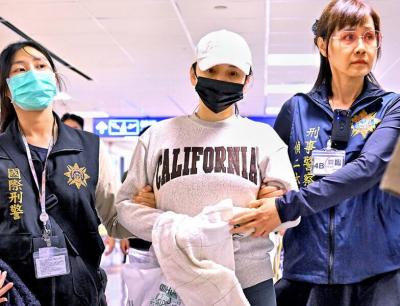
Johanne Liou (劉喬安), a Taiwanese woman who shot to unwanted fame during the Sunflower movement protests in 2014, returned to Taiwan last night after being deported from the US. She is to stand trial in Taiwan for charges involving embezzlement, fraud and drug crimes. The Criminal Investigation Bureau (CIB) said it took her into custody at Taiwan Taoyuan International Airport and would first question her before transferring her to the New Taipei District Prosecutors’ Office. She was arrested upon disembarking a flight from San Francisco that landed shortly before 7pm. Liou absconded to the US in 2019 after jumping bail

Shih Hsin University President Chen Ching-he (陳清河) yesterday issued a public apology for comments made in his commencement speech last week, stating that he has asked the school to suspend his duties and halt his wages for two months as a show of contrition. At the commencement ceremony on May 30, Chen said, “If you don’t manage your time well, or your own emotions, or your health, then I am telling every one of you — put a quick end to ‘you,’ because the world has no need for ‘you.’” The comments have sparked significant controversy online, and Chen through an open


 RSS
RSS